1
News
The subtle art of Low Friction Extraction
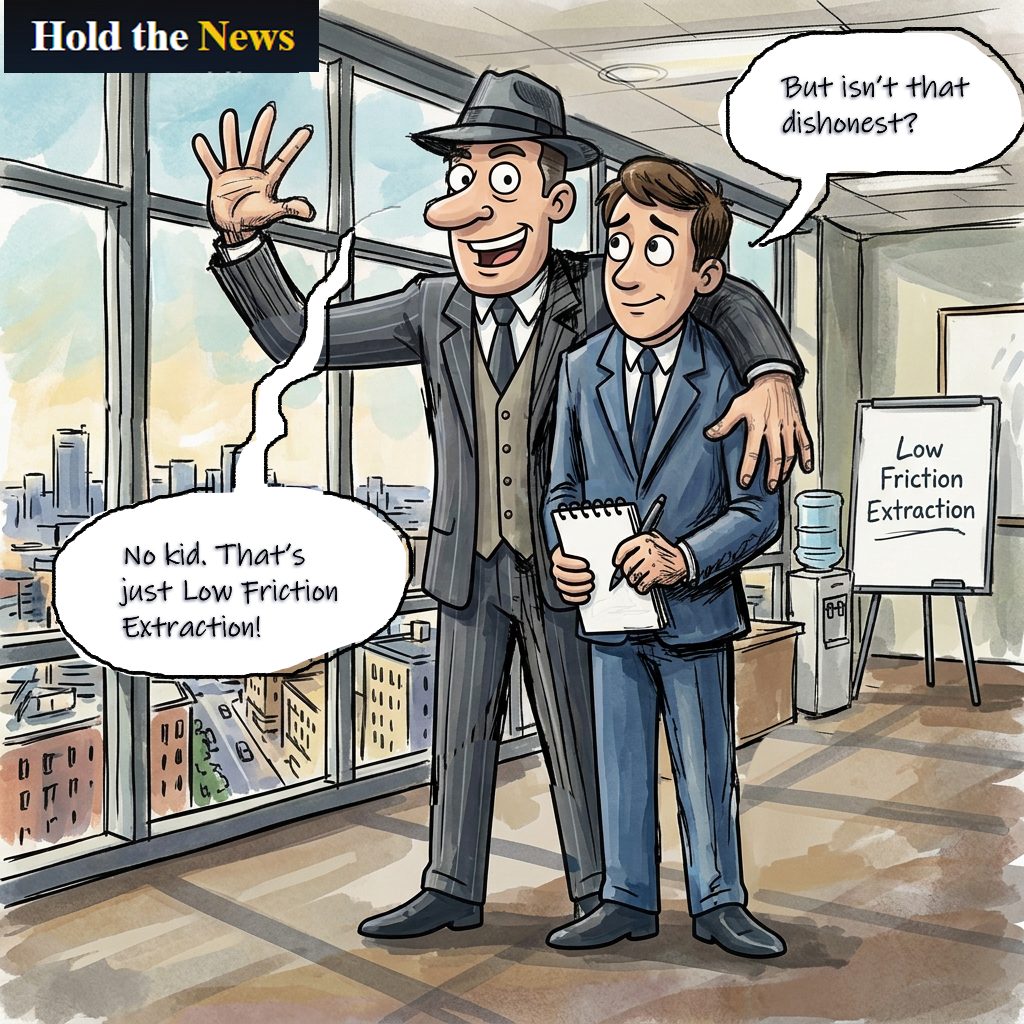
Low Friction Extraction - Created by Gwynn Earl for HOLD THE NEWS
You’ve probably never heard the term, but you’ve almost certainly fallen a victim to it.
But what is ‘Low Friction Extraction?’
It's the subtle and sinister art of extracting millions of dollars from consumers by imposing small fees on thousands of customers. A minor inconvenience that adds up over the year, whilst the executive who came up with it lines his pocket with shiny bonuses.
Whilst the average consumer struggles with the cost of living, and wondering why they seem to have more and more expenses each month, company revenues grow by millions.
There’s now a hundred of these little tricks and traps, which you probably don’t even notice, and maybe you should start paying more attention. Here are just a few subtle ways they are skimping dollars everywhere they can reach.
The Introductory-rate expiry: A cheap first-year plan automatically reverts to a much higher default price.
Insurance renewal increases: The premium rises annually, while an identical policy is offered more cheaply to new customers.
Foreign-exchange spreads: “No commission” is advertised, but the provider quietly uses an unfavourable exchange rate.
Payment-processing fees: A small percentage is taken from every transaction and ultimately incorporated into retail prices.
Automatic subscription renewals: A free trial or discounted subscription converts into a paid plan without meaningful prompting.
Difficult cancellation: Joining takes one click; cancelling requires menus, telephone calls or waiting for an agent.
Unused account fees: Monthly charges continue on dormant accounts because closing or transferring them requires effort.
Minimum account or transaction fees: A small fixed fee disproportionately affects low-value purchases and small balances.
Late-payment fees: A minor delay produces a charge far greater than the provider’s actual administrative cost.
Credit-card interest traps: Losing the interest-free period can cause interest to be calculated from an earlier date or across the full balance.
Reward-point expiry: Benefits already earned disappear after an inactivity period or an obscure program change.
Delivery and service fees: A low headline price grows through handling, platform, booking or “service” charges at checkout.
Preselected extras: Insurance, donations, tips or premium options are added unless the customer actively removes them.
Small package reductions: The price remains unchanged while the quantity quietly falls—effectively a concealed price increase.
Unclaimed refunds and credits: Small positive balances remain with the company because claiming them takes more effort than they are individually worth.
Refund friction: Store credit is offered automatically, while obtaining an actual cash refund requires additional steps.
Bill smoothing and estimates: Overestimated usage gives the provider an interest-free loan until the account is eventually reconciled.
Paper-statement and payment fees: Customers are charged for receiving a bill or paying it through particular channels.
Default charitable “round-ups”: Individually tiny amounts are collected through prompts designed to make refusal feel awkward.
Price escalation through personalisation: The company estimates each customer’s likelihood of switching and increases prices accordingly.
If you are suddenly feeling a lot poorer, and searching through bank statements with a look of horror on your face. Don’t worry. That only indicates you are still sane.
But what is ‘Low Friction Extraction?’
It's the subtle and sinister art of extracting millions of dollars from consumers by imposing small fees on thousands of customers. A minor inconvenience that adds up over the year, whilst the executive who came up with it lines his pocket with shiny bonuses.
Whilst the average consumer struggles with the cost of living, and wondering why they seem to have more and more expenses each month, company revenues grow by millions.
There’s now a hundred of these little tricks and traps, which you probably don’t even notice, and maybe you should start paying more attention. Here are just a few subtle ways they are skimping dollars everywhere they can reach.
The Introductory-rate expiry: A cheap first-year plan automatically reverts to a much higher default price.
Insurance renewal increases: The premium rises annually, while an identical policy is offered more cheaply to new customers.
Foreign-exchange spreads: “No commission” is advertised, but the provider quietly uses an unfavourable exchange rate.
Payment-processing fees: A small percentage is taken from every transaction and ultimately incorporated into retail prices.
Automatic subscription renewals: A free trial or discounted subscription converts into a paid plan without meaningful prompting.
Difficult cancellation: Joining takes one click; cancelling requires menus, telephone calls or waiting for an agent.
Unused account fees: Monthly charges continue on dormant accounts because closing or transferring them requires effort.
Minimum account or transaction fees: A small fixed fee disproportionately affects low-value purchases and small balances.
Late-payment fees: A minor delay produces a charge far greater than the provider’s actual administrative cost.
Credit-card interest traps: Losing the interest-free period can cause interest to be calculated from an earlier date or across the full balance.
Reward-point expiry: Benefits already earned disappear after an inactivity period or an obscure program change.
Delivery and service fees: A low headline price grows through handling, platform, booking or “service” charges at checkout.
Preselected extras: Insurance, donations, tips or premium options are added unless the customer actively removes them.
Small package reductions: The price remains unchanged while the quantity quietly falls—effectively a concealed price increase.
Unclaimed refunds and credits: Small positive balances remain with the company because claiming them takes more effort than they are individually worth.
Refund friction: Store credit is offered automatically, while obtaining an actual cash refund requires additional steps.
Bill smoothing and estimates: Overestimated usage gives the provider an interest-free loan until the account is eventually reconciled.
Paper-statement and payment fees: Customers are charged for receiving a bill or paying it through particular channels.
Default charitable “round-ups”: Individually tiny amounts are collected through prompts designed to make refusal feel awkward.
Price escalation through personalisation: The company estimates each customer’s likelihood of switching and increases prices accordingly.
If you are suddenly feeling a lot poorer, and searching through bank statements with a look of horror on your face. Don’t worry. That only indicates you are still sane.