AUSTRALIAN JOURNAL
October 12, 2026 ❄
◀ Edition #81 ▶
Opinion  ·  Science & Tech  ·  Fiction  ·  Opinion  ·  Science & Tech  ·  Fiction  ·  
1
Opinion
Why does the ABC keep discussing EVs as if they were petrol cars?
eV Charging
eV Charging - Chuttersnap - Unsplash
Recently, ABC energy reporter Daniel Mercer was interviewed by Sam Hawley about the adoption of EVs in Australia. Sam Hawley, presumably not an eV driver himself, talked about the lack of roadside charging infrastructure and long queues at Easter.

While it is certainly possible for a queue to build up at peak periods, a charging queue is hardly the highlight of an EV owner’s life.

As an EV driver for almost six years, I can count on one hand the number of times I have used a roadside charger, and for me it has always been a smooth experience.

The fact is, most EV owners fortunate enough to have off-road parking and access to charging charge their cars overnight. Exactly as one might do with a mobile phone.

For many vehicles, that will let you start your day with 400 km of range.

How often do you drive more than 400 km in a single day?

To me, range anxiety is something I recall from the good old petrol days.

Regrettably, there has been a significant amount of negative commentary about EVs on social media. I sometimes wonder how much of it is encouraged by those who stand to lose.

In my experience, EVs outshine petrol cars on almost every metric that matters to me: smoother ride, more fun to drive, almost no service cost and significantly cheaper to drive.

As EV adoption progresses through the S-curve, we will need more roadside chargers, and I expect existing providers of this infrastructure will expand their networks. Where there is a profitable business opportunity, why would they not?

No, I believe the biggest and most important problem to solve in urban Australia is making affordable charging available to tenants and owners of car spaces in existing apartment buildings and offices.

It shouldn’t matter whether you park your car in a driveway or in a private car space. Everyone should have the right to charge their car at comparable electricity rates.

Strata organisations and bodies corporate that outsource the installation of charging infrastructure to third-party, for-profit companies are potentially locking their tenants and owners into paying premium rates for years.

I have witnessed firsthand how frustrating it can be when the installation of EV chargers is debated by members of a strata committee who themselves don’t drive an EV.

In Australia, wholesale electricity can be very cheap, even negatively priced, in the middle of the day. That doesn’t mean it is free at the power point, but it would make perfect sense for people who commute to work to charge at work.

The government should consider incentives for employers who want to offer employees free charging at work. Not only could this help absorb surplus solar power, but it’s also an incentive to get employees back to the office.

Free EV charging at work—maybe something for the ABC to consider.


ABC Radio National
2
Science & Tech
Scientists: Chronic loneliness as harmful as smoking 15 cigarettes a day
loneliness
loneliness - Created in Canva
Most of us think of loneliness as a feeling. An unpleasant one, sure, but something that simply comes and goes after catching up with a friend or missing our family from afar.

Scientists now say it's far more than that.

According to the World Health Organization, the U.S. Surgeon General and a growing body of medical research, chronic loneliness is emerging as one of the most significant public health challenges of our time. It's being linked to everything from heart disease and dementia, to depression, anxiety and a shorter lifespan.

In other words, loneliness isn't just about feeling sad, it can have real consequences for both our physical and mental health.

Your brain was built for connection
Humans have spent hundreds of thousands of years living in families, tribes and close-knit communities. For almost all of our evolutionary history, being separated from other people wasn't just unpleasant, it could be dangerous.

Scientists believe that's why loneliness exists in the first place.

Much like hunger tells us we need food, and thirst reminds us to drink; loneliness is thought to be a biological signal encouraging us to reconnect with other people. It's the brain's way of telling us that something important is missing.

The problem comes when that signal doesn't go away.

When loneliness becomes chronic
Researchers are increasingly finding that prolonged loneliness can affect nearly every part of the body.

Studies have linked chronic loneliness to higher levels of stress hormones, increased inflammation, poorer sleep, reduced immune function and a greater risk of developing conditions such as heart disease, stroke, type 2 diabetes, depression and dementia.

One of the most widely discussed findings came from the U.S. Surgeon General's landmark report on social connection, which concluded that the health risks associated with prolonged social isolation and loneliness are comparable to smoking up to 15 cigarettes a day, and may exceed the risks linked to obesity and physical inactivity.

That doesn't mean loneliness causes these conditions on its own. Rather, it appears to be one of many important factors that can influence our health over time.

A modern problem in a connected world
Perhaps the biggest surprise is that loneliness isn't confined to older people living alone.

Research shows it can affect people of every age, including teenagers and young adults, despite living in a world where we're more digitally connected than ever before.

Scientists believe that's because social connection isn't measured by the number of people in your contact list or followers on social media.

Instead, it depends on whether we have meaningful, supportive relationships where we feel understood, valued and connected.

It's possible to feel lonely in a crowded room, and equally possible to feel deeply connected with just a handful of close relationships.

A health issue we can all help address
Recognising loneliness as a public health issue doesn't mean every lonely day is cause for alarm. Everyone feels lonely from time to time, especially after major life changes, moving house, losing a loved one, starting a new job and so on.

The concern is when loneliness becomes persistent and begins affecting a person's wellbeing over weeks, months or even years.

That's why organisations such as the World Health Organization are calling for loneliness and social isolation to be treated as seriously as other major health risks. Researchers say strengthening social connection isn't simply good for our happiness, it may also play an important role in supporting our long-term health.

SOURCE
WHO Commission on Social Connection
U.S. Surgeon General: Our Epidemic of Loneliness and Isolation
WHO News
3
AD Advertisement
Write For Hold The News
Advertisement image
Have something worth saying?

Do you feel compelled to write, have a story to tell or a message you want to share with fellow Australians?

Join our team of volunteer writers and give it a fair go.

We publish articles across a wide range of topics and let readers decide what's worth reading. A new edition is released every Monday, with articles ranked according to the number of reads they receive.

Register here to become a writer, or contact us if you have any questions.

Not ready to write just yet?

Subscribe here and follow Hold The News to see what others are writing.

You can also submit a follow up article to a current or past article if you have something to add.

Steven Sesselmann (editor)
4
Science & Tech
The farm of the future may not have any animals
cow-free-farms
cow-free-farms - Canva
Picture a dairy farm with no cows. An egg farm without chickens. A leather factory that never uses animal hides. It sounds like science fiction, but scientists say that future is already beginning to arrive.

Before you picture another plant-based substitute, here's the surprising part. This isn't oat milk. It isn't soy milk. And it isn't another imitation product. Scientists are now producing the very same proteins found in cow's milk, just without the cow.

Around the world, researchers and food companies are using tiny microbes, similar to the yeast used to brew beer, to produce the same proteins found in milk, eggs, gelatin and other animal products, all without raising the animals themselves.

It's a technology called precision fermentation, and it's quietly making the leap from research laboratories into supermarket products, with the potential to reshape the way we produce food.

The same proteins, just made differently
At first, it sounds impossible. How can you make milk without a cow?

The answer lies in biology. Scientists identify the specific proteins that give foods like milk and eggs their unique properties, then give carefully selected microbes the genetic instructions needed to produce those exact same proteins inside large stainless steel fermentation tanks.

It's remarkably similar to the way insulin has been made for decades. Instead of relying on animals, the microbes do the work. Once the fermentation process is complete, the proteins are purified and used as ingredients in food products.

The result isn't a plant-based substitute trying to imitate dairy or eggs. It's animal-identical proteins, produced in a completely different way.

More than just milk
While dairy proteins have attracted the most attention so far, the technology is expanding rapidly.

Scientists are now producing egg proteins for baking, collagen and gelatin for foods and medicines, leather without animal hides, and specialty ingredients used in products ranging from chocolate to nutritional supplements.

Some of these products are already being sold in countries including the United States and Singapore, while many more are moving through regulatory approval and commercial development.

Researchers believe precision fermentation could eventually become an important complement to traditional farming, particularly as the global demand for protein continues to grow.

Why scientists are excited
The appeal isn't simply novelty.

Because precision fermentation produces only the specific proteins being targeted, studies suggest it has the potential to use fewer natural resources than conventional livestock farming while reducing greenhouse gas emissions, land use and water consumption. Scientists are continuing to study exactly how large those environmental benefits could be as the technology scales up.

Supporters also believe producing proteins this way could make food production more resilient by reducing dependence on weather, droughts and animal disease outbreaks.

That doesn't mean cows, chickens and traditional farms are about to disappear. Most researchers see precision fermentation becoming another tool in the global food system rather than replacing agriculture altogether.

Still, it's remarkable to think that some of tomorrow's milk, eggs and other everyday ingredients may begin life not on a farm, but inside a gleaming stainless steel tank. Just a few years ago, that idea belonged firmly in the realm of science fiction. Today, it's becoming science fact.

Sources
Nature Reviews Bioengineering
Annual Review of Food Science and Technology
Current Opinion in Food Science
6
Science & Tech
AI models: Can you change the way they think?
AI Agent
AI Agent - AI Generated
Most people are familiar with AI chatbots like ChatGPT and Claude, but in recent months agentic AI programs like OpenClaw have become widespread and popular.

AI agents like OpenClaw are more than just chatbots. They typically run on a computer that you control and use an advanced AI model of your choice to carry out complex tasks on your behalf.

The agent typically divides a complex task into several simpler tasks and carries them out in sequence.

While this sounds like a dream, it can quickly become a nightmare, especially if the agent misunderstands your instructions. It may simply start carrying out your instructions at breakneck speed, so if you told it to clean up your hard drive it might just do that by deleting all your files.

In my case I have a spare PC with limited access to my network, which I use exclusively to run OpenClaw. Even if things were to go badly wrong it can't do much damage.

Typically one communicates with one's agent via text or speech using an app like WhatsApp or Telegram. You give it an instruction and it quickly figures out how to do it.

What's the point, you might ask?

Agents can carry out almost any digital task you ask them and trust them to do.

In my case I asked it to write the code for a digital news platform, I explained my vision of how I wanted it to look and feel and voila - you are looking at the site right now.

For sure, a few tests and iterations were needed until the site looked the way I wanted, but even though I am relatively experienced at coding, I never touched a single line of code.

I also asked OpenClaw to back up my code once a day, which it does faithfully. You see, OpenClaw can run scheduled tasks, and it also has a “heartbeat” that wakes it up at regular intervals to check if anything needs doing.

How can agents make you smarter?

One of the daily tasks I assigned to my agent was for it to send me an interesting question to ponder over during my morning coffee at around 6:00 am. It's the time of day when my brain is waking up and ready to tackle the day's problems.

We agreed that random questions would be generated from a list of topics that were interesting to me. Of course you could choose your own topics. These were mine:

1. physics & cosmology
2. philosophy of mind
3. mathematics & logic
4. history & civilisation
5. ethics & decision theory
6. biology & evolution
7. economics & complexity
8. language & meaning

Now, every morning it generates one question for me. For example:

Language shapes thought — but does it also constrain it? When you're working through a physics problem in your head, is the reasoning happening in words, in something more like spatial or mathematical intuition, or in something that has no name yet? And if the deepest thinking happens before language, what exactly is language doing when you finally write it down?

I ponder the answer and reply to the best of my understanding.

It then records both its question and my answer along with its own summary in a daily "persona" file stored locally on my PC.

Sometimes it gives me feedback about how it understands my answer and why it thinks the answer is good or bad.

The ultimate aim of this experiment is to encourage thinking, make me smarter and build a large data set of my thoughts and opinions, which may one day be used to fine-tune a large language model.

Fine-tuning involves taking an already trained AI model and giving it further training using new examples. In my case, those examples would be my own thoughts and answers, helping it respond more like I would.

Such a fine-tuned model might capture a little bit of the way I think.

Think of it as a photo album of thoughts, that your grandkids can one day interact with. So much more than a photo.

Which just shows that AI doesn't have to change the way you think, you can also change the way AI thinks.

OpenClaw
8
Fiction
The Other Panopticon (5g)
The Other Panopticon
The Other Panopticon - Original
Chapter 5g

Earlier Chapters:
Synopsis
Chapter 1
Chapter 2
Chapter 3
Chapter 4


Celina’s account took close to an hour to work through. Enzo’s was somewhat shorter. He had not taken contemporaneous notes that week as he was occupying a room at the fishing camp in the company of Bruce and Kurt Cunningham.

‘Didn’t want to raise any suspicions,’ he announced, ‘so I scribbled down the key points of my contact with Bruce and Kurt when I got home. Portia reckons she can still smell fish all though our house.’

‘Fire away,’ I replied, not realising we were about to be entertained with a ‘one-that-got-away’ fish story from hell.

‘On day one we pulled into the Mary River campsite at the Point Stuart Wilderness Lodge, just before dawn,’ he began. ‘Bruce and Kurt had to sort through some of their gear, which left Celina and me to settle into our digs in adjoining rooms, then have a quiet drink together at the bar, remembering that neither of us had met before.’

‘That’s when we came up with the ‘Live and Let Die’ ringtone plan since I knew Kurt was bent on jumping my bones,’ added Celina.

‘After dinner, all of us managed to drink a fair bit that night,’ continued Enzo, ‘with most of the conversation centred around where we would be fishing the next day.’

‘Did either of the Cunninghams talk about themselves, their family background or anything other than fishing?’ I asked.

‘Bruce mentioned his and his wife Beryl’s connection with the cathedral church in Darwin,’ said Enzo. ‘He said Beryl has been employed as the administrator there for about six years and is heavily involved with that church’s leadership team. Kurt mainly talked about some of his ex-girlfriends, of which there appear to be many.’

‘Nothing else?’

‘Not from that evening,’ said Enzo, but, as Celina has indicated, I caught young Kurt knocking on her door on one occasion that evening, under the influence, no doubt of the large number of stubbies (of beer) he’d consume at the bar.’

‘Are we up to day two now?’ asked Hannah, itching to move things along.
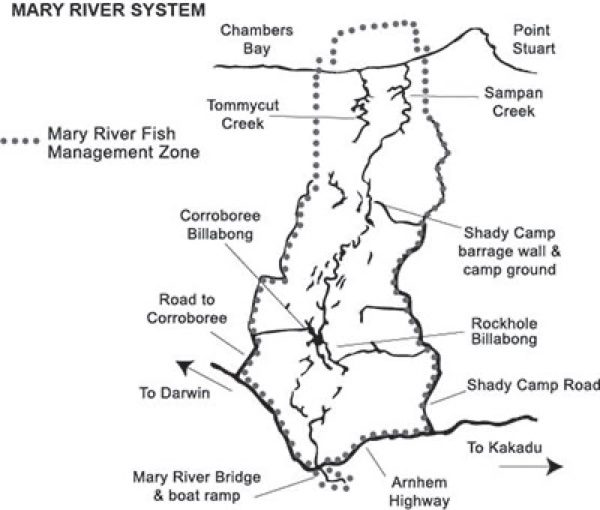
‘Of course,’ he replied. ‘We were up at six the next morning, breakfast at seven and on the road by eight. We launched the runabout tinnie at Sampan Creek and made our way upstream on the Mary River to the Shady Camp barrage wall where the tide brings the bigger barras into play.
He pulled out a sketch he’d done of the ‘Mary River System’ and walked us through each fishing site the team had visited that day.

Mary River Map
Mary River Map - Original


‘Bruce and Kurt caught a few undersized barras,’ Celina interrupted, ‘but there wasn’t much of any size at any of the billabongs we came to …’
‘ … until we doubled back to Sampan Creek,’ said Enzo. ‘And finally, I hooked and landed my first barramundi – undersized but it put up a great fight.’

‘Then we made our way back along the river to the highway,’ Celina chimed in. ‘The guys were too busy knocking off the rest of the beer to fish any more, but I decided to do some trawling and that was when I struck gold.’
She nodded in Enzo’s direction.

‘Celina hooked an enormous threadfin,’ he announced, ‘and the bloody thing took off then starting towing our tinnie towards the shoreline.’
‘The tip of my rod was bending down into the water,’ added Celina. ‘I could see the fish charging torpedo-like through the shallows just in front of our boat.’

‘The threadie was at least a metre long, Bruce reckoned,’ continued Enzo. ‘But it was taking us towards the shoreline where a couple of salties were basking in the hot summer sun.’

Celina took over.

‘The fish seemed to be heading for a submerged tree trunk,’ she said, ‘then suddenly all hell broke loose. One of the salties latched onto it and began tear it in half with its massive jaws.’
‘That’s when our tinnie began to flounder,’ continued Enzo. ‘The tumbling crock and his prey rolled towards us then under our boat and suddenly the four of us were in the water.’

‘Jesus!’ exclaimed Hannah.

‘You didn’t mention anything about this in your report, Celina,’ I growled.

‘I decided to let Enzo tell the story,’ she replied. ‘Or at least most of it.’

‘And the ending?’

‘Not a happy one, I’m afraid, ’at least for Bruce and Kurt. The tinnie was waterlogged and slightly damaged. It took the rest of the day to get it started and back onto the river again.’

‘You must have been terrified – upended in crocodile-infested waters!’ Hannah muttered.

‘We managed to scramble onto the nearby shoreline,’ said Enzo, ‘before the crocs could get a piece of us. Bruce had to use his semi-automatic rifle to keep them at bay while the three of us hauled the tinnie higher up onto dry land and emptied the water out of it.’

‘And the giant threadfin?’ I asked.

‘The saltie and his mate got most of it, but its head eventually floated to shore so we claimed it as a catch, or at least Celina did.’

Hannah had a wry smile about her.

‘Are you two having a lend of us with all this?’ she asked.
Enzo fished something from his pocket.

‘Not according to this,’ he declared, laying a photo of what appeared to be the disembodied head of a large threadfin displayed on the keel of an upturned tinnie.’

‘You sure you didn’t photoshop this after a quick visit to the Darwin fish-market?’ I asked.

‘Positive,’ replied Enzo, then he removed another item from his pocket.
‘There is one other thing,’ he added. ‘When the tinnie overturned, Bruce screamed something that sounded rather East European. I wrote it down on this piece of paper. I can still hear the sound of it – ‘siran gas pondiya’. I asked Intan what it meant but he’s not familiar with East European languages.

‘I am,’ said Hannah, ‘and if I’m not mistaken, it’s probably a Russian profanity pronounced ‘sran gospodnya’.

My co-director was full of surprises. I glanced at her – awaiting the punchline.

‘It literally means – ‘holy crap’!’ she declared.


Continued Article 725